← All materials Visual Atlas
Atlas of mechanisms — the academic sources behind the video
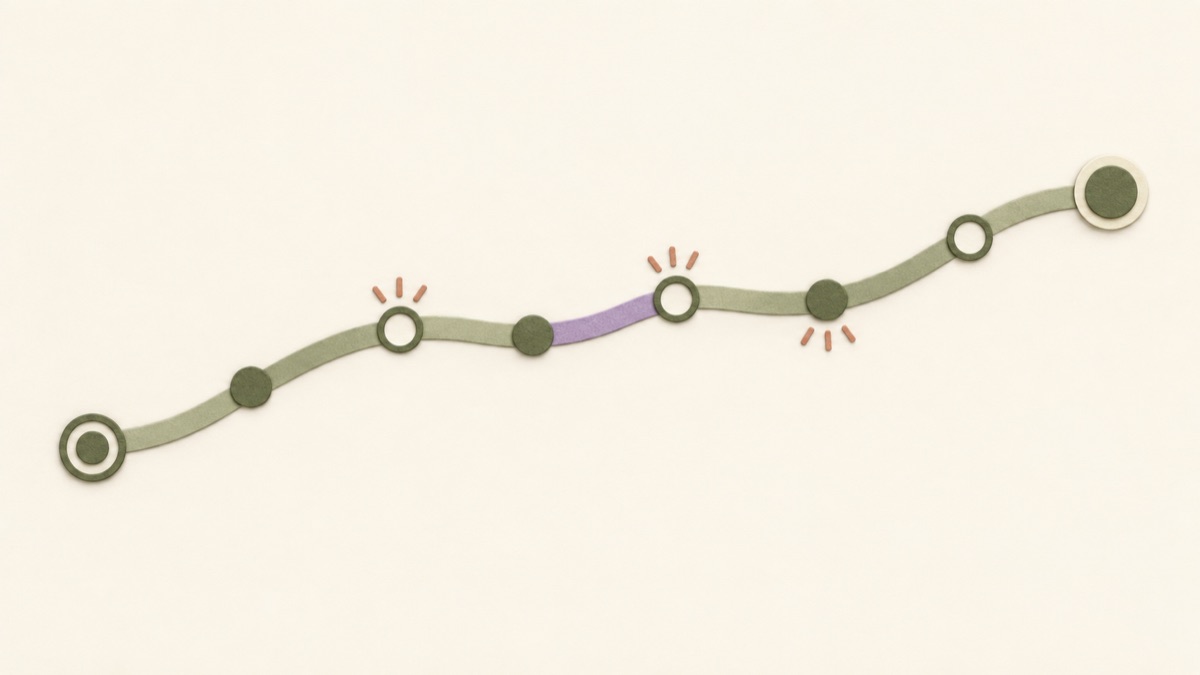
Atlas of mechanisms
This atlas links eight academic sources to a route that runs from the outside view all the way to blaming the victim. It does not mix theory, experimental findings, and the dramaturgy of the video. Instead it shows what each mechanism is genuinely able to explain — and where the justified transfer ends.
The map in four zones
The overall map has four zones. First, the outside view amplifies self-observation and emotional labour. Second, norms and expectations shape reputation and the working persona. Third, constrained choice ties together attachment, uncontrollability, and coercion. Finally, the observer can blame the victim to restore a sense of order. This is an editorial route across distinct studies — not one universal scientific model.
Zone one — emotional labour
If an organization pays not only for an action but for the right emotional impression, managing feelings becomes part of the job. A person sells the client calm, care, interest, or firmness.
- Hochschild's mechanism
- 1979-01-01feeling rules — culture dictates what one should feel, how strongly, and for how long
- 1983-01-01emotional labour — feeling management becomes part of the paid role
- 1983-06-01flight attendants sell warmth; bill collectors sell coldness
The mechanism develops step by step. The organization sets a rule: the client must receive safety, special attention, trust, or fear. The worker notices the mismatch — real irritation, fatigue, or anxiety against the required emotion. Surface acting changes only the expression; deep acting tries to change the felt experience itself. The cost is a possible estrangement from one's own feelings, though professional distance can sometimes protect at the same time.
Emotional labour is not a synonym for kindness: coldness can be the product being sold.
Boundary of the explanation: a single polite reply does not demonstrate chronic estrangement or exploitation, and deep acting is not automatically more harmful than surface acting — outcomes depend on frequency, autonomy, and support.
Zone two — norms, reputation, the working persona
The second zone collects the mechanisms by which an audience's expectations turn into a persona the worker must keep performing. The working persona is durable: it persists between shifts, it is rehearsed, and it is audited by observers. What the research in this zone explains is the stability of the performance — why it does not switch off when the customer leaves.
Boundary of the explanation: these studies describe regulated service roles. Transferring them to coercive settings adds force, threats, and control that the original research never measured.
Zone three — constrained choice
The third zone connects attachment, uncontrollability, and coercion. Where exit is expensive and the future is opaque, choices narrow in a way that outside observers systematically underestimate. The mechanisms here explain why staying is not evidence of consent.
Boundary of the explanation: constrained choice widens the vocabulary of coercion, but it does not convert every constrained situation into a coerced one — the transfer must be argued, not assumed.
Zone four — blaming the victim
In the final zone the observer enters the picture. Blaming the victim restores the observer's sense of order: if the outcome is the victim's fault, the world remains just. The research in this zone explains the pull of that move — why it is cheap, satisfying, and repeatable.
Where the video stretches the sources: the transfer from legal service work to exploitation adds coercion, threats, and control that the original studies did not measure, and the claim that deep acting is categorically more dangerous is too strong.
How to read the atlas
Each mechanism earns exactly the claim its study supported — no more. The route is editorial; the boundaries are the point. When a mechanism's boundary is crossed, the atlas says so in the same breath as the claim.